Why You Can't Start: Untangling Task Paralysis
It isn't laziness. It's a planning problem — and planning problems have planning solutions.

You've been meaning to start it for two weeks. It's on every list you've written. You've thought about it in the shower, on the walk, at 11pm when you should've been asleep. And yet the document is still blank, the email still unsent, the project still untouched. Not because you're lazy — you've done harder things — but because every time you sit down to begin, your mind quietly slides off the task like water off glass.
This is task paralysis, and it has almost nothing to do with discipline. It's a predictable response to a specific kind of problem: one that's too large and too vague to picture in a single glance. Understanding why your brain stalls is the first step to designing your way out of it.
The task isn't hard. It's invisible.
When you look at a task like "write the quarterly report" or "plan the offsite," your brain tries to do something reasonable: simulate the work. It reaches for a mental picture of the finished thing and the path to get there. But for a big, fuzzy task, there is no clear picture — just a fog of half-formed steps, unknowns, and dependencies.
Faced with that fog, the brain does what brains do with uncertainty: it flags the whole thing as threatening and recommends avoidance. You feel a small spike of dread, you open another tab, and the task quietly slides to tomorrow. The problem was never the difficulty of the work. It was the impossibility of seeing it.
A task you can't picture is a task you can't start. The fog isn't a character flaw — it's missing information.
This is why "just push through it" advice tends to fail. Willpower can force you into the chair, but it can't conjure the missing picture. You sit there, stare at the fog, burn energy, and leave feeling worse. The fix isn't more force. It's more resolution — breaking the task down until you can actually see the next move.
Three forces that keep you frozen
Task paralysis usually runs on some mix of three quietly reinforcing loops. Most stuck projects have at least two of them running at once.
1. Ambiguity tax
Every undefined step costs energy before you've done any work at all. "Write the report" secretly contains decide the structure, find last quarter's numbers, figure out what the audience cares about, and a dozen more. Your brain pays that tax up front, feels the weight, and recoils. The bigger the ambiguity, the steeper the tax.
2. All-or-nothing framing
When a task is stored in your head as one giant block, there's no such thing as partial progress. You can't be "12% done with the report" if the report is a single undifferentiated lump — you're either finished or you haven't started. That framing makes every work session feel like it has to be the heroic one, which is exactly the pressure that makes you avoid sitting down at all.
3. Working-memory overflow
Holding a whole project in your head — all the steps, the order, the things you mustn't forget — overflows working memory fast. The result is a low background hum of I'm definitely forgetting something, which reads as stress, which sends you straight back to avoidance. People with ADHD feel this one especially sharply, but no one is immune to it.
All three forces share one root cause: the task lives in your head as a single, blurry block. Get it out of your head and split it into pieces small enough to see, and all three loosen at once.
The move that breaks it: shrink the first step until it's boring
Here's the counter-intuitive part. The goal of breaking a task down isn't to plan the whole thing perfectly. It's to find a first step so small it's almost embarrassing to write down — small enough that starting requires no courage at all.
"Write the report" is a wall. "Open a blank doc and paste in last quarter's three section headings" is a step you can do in ninety seconds without any dread. And here's the trick: once the doc is open and the headings are there, the next small step is suddenly visible. Momentum isn't something you summon before you start. It's something starting creates.
The practical rule I give people who are stuck: keep splitting the task until the first leaf feels like ten minutes of obvious work. If you still feel the dread, you haven't split far enough. Go one level smaller. The dread is your signal, not your verdict.
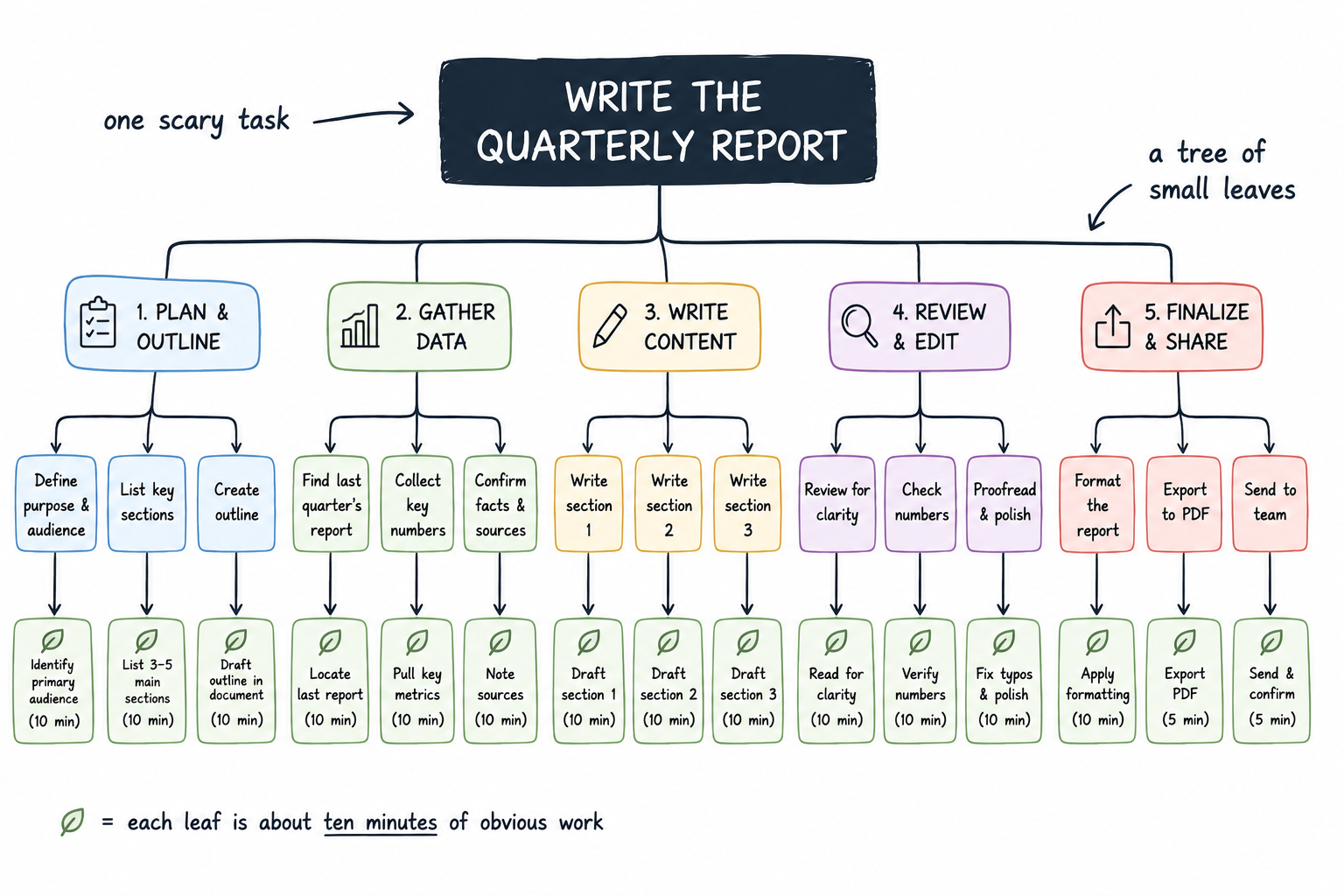 A single intimidating task, broken down until each leaf is a ten-minute job you can picture.
Why breaking down beats powering through
When you split a task into small, concrete leaves, you defuse all three forces in one move:
- The ambiguity tax drops to near zero — each leaf is specific, so there's nothing to decide before you begin.
- All-or-nothing framing disappears — finishing one leaf is real, visible progress, even if it's the only thing you do today.
- Working memory empties out — the plan now lives on the page, not in your head, so the background hum of "don't forget" goes quiet.
There's a quieter benefit too. Each completed leaf is a small hit of "done" — and those add up into momentum that carries you into the next one. You stop relying on motivation, which is unreliable, and start relying on structure, which isn't.
A 5-minute unsticking drill
Next time you catch yourself frozen, don't try to do the task. Do this instead:
- Write the scary task at the top of a page, exactly as it lives in your head.
- Underneath, list every smaller piece it secretly contains — don't filter, just empty your head onto the page.
- Pick the one piece that feels easiest and split that into two or three even smaller steps.
- Find the single step you could start in the next ten minutes without any dread. Circle it.
- Do only that. When it's done, the next step will already be visible.
Notice what this drill is really doing: it's pulling the project out of your head and onto the page, where it stops being a fog and becomes a list. You're not forcing yourself to work. You're making the work small enough that starting stops being scary.
The point isn't productivity. It's relief.
It's tempting to frame all of this as a way to get more done. But the real prize is quieter than that. When the project you've been avoiding is finally broken into pieces you can see, the dread that's been following you around — to dinner, to bed, to the weekend — loosens its grip. You get the project back to a manageable size, and you get your head back too.
You don't need more discipline. You need a smaller first step. Find the leaf that feels boring, do that one, and let starting do the rest.
Maya Reyes
Maya writes about calm productivity systems for people who'd rather do the work than manage the to-do list.
Turn one scary project into a tree of small wins.
Branchify is built around the one move in this article: keep splitting until starting is easy. Free forever plan, no credit card, works right in your browser.
Launch plan
Branchify board
You might also like
All articles
The 10-Minute Rule: Make Any Task Small Enough to Start
The 10-Minute Rule breaks any overwhelming task into tiny, frictionless steps, eliminating the freeze response and making it easier for your brain to start.

Why Short, Honest Work Sprints Beat Long Grinding Sessions
Short focused work sprints turn work into timed blocks with real breaks, lowering the bar for starting and making stopping guilt-free today.