The 10-Minute Rule: Make Any Task Small Enough to Start
Task paralysis is a sizing problem, not a willpower problem. Shrink any goal to a ten-minute step and your brain's freeze response has nothing to latch onto.
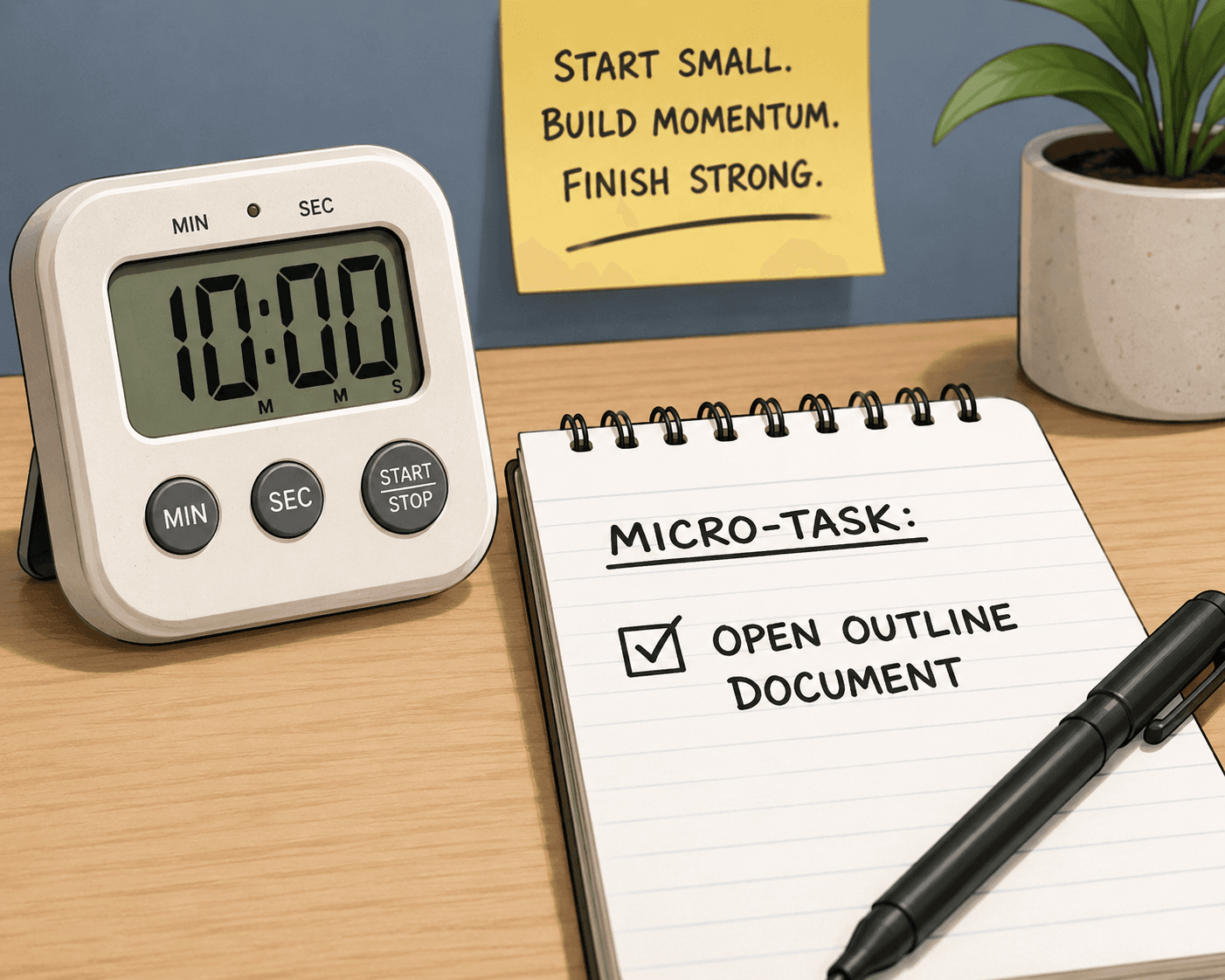
If you struggle with task paralysis, the problem isn't your willpower or your motivation. The real culprit is the sheer size and vagueness of your goals, which trigger a protective freeze response in your brain. By using the 10-Minute Rule, you can bypass this mental block and turn overwhelming projects into tiny, frictionless steps that feel impossible to fail.
Why the First Step Feels Like a Mountain
It is Tuesday morning. You have a fresh cup of coffee on your desk, your calendar is clear, and you have a solid block of time dedicated to working on your most important project. For a freelancer, this might be designing a client's website. For a student, it could be studying for a massive final exam. For a solopreneur, it might be drafting an email sequence for a new product launch. You know exactly what is at stake, you understand the deadline, and you genuinely want to do the work.
Yet, as you stare at the blank screen, something inside you locks up. Your chest tightens slightly. A wave of profound fatigue washes over you. Instead of opening your work files, you find yourself opening a new browser tab to check the news, pacing around your room, washing a coffee mug that was already clean, or meticulously sorting your email inbox.
Hours pass. You have done a lot of things, but none of them were the actual work you planned to do. By evening, you feel completely drained, thoroughly defeated, and wrapped in a heavy blanket of guilt.
This experience is not laziness. Laziness is a conscious choice to rest without guilt. What you are experiencing is a specific, agonizing psychological state known as task paralysis. It is a state where the desire to act is high, but the ability to initiate that action drops to zero. When a project feels too large, your brain stops viewing it as an assignment and starts viewing it as a direct threat to your energy levels. The mountain looks so steep that your mind decides it is safer to stay at the base. If you find yourself stuck in this immobilizing loop day after day, understanding the difference between active avoidance and neurological exhaustion is the first step toward breaking free.
The Friction of Vague Goals: What Happens in the Brain
To understand why we freeze up in front of our computers, we have to look under the hood at how the human brain processes information. When you put an item on your schedule like "Work on marketing campaign" or "Study chapters 5 through 10," you think you are giving yourself a clear instruction. In reality, you are handing your brain a massive, shapeless blob of uncertainty.
The human brain hates uncertainty. The amygdala — the ancient, emotional region of the brain responsible for identifying danger — constantly scans your environment for threats. When it encounters a highly ambiguous, high-stakes project, it registers that ambiguity as an emotional risk. It fears failure, judgment, or intense cognitive discomfort. To protect you, the amygdala triggers a mild, subconscious fight-or-flight response. Because you cannot physically fight a spreadsheet and you cannot run away from a client proposal, your nervous system defaults to the third option: it freezes.
Meanwhile, your prefrontal cortex — the modern part of the brain responsible for planning, working memory, and decision-making — is forced to do far too much heavy lifting all at once. If you experience executive dysfunction, which is common among individuals with ADHD, chronic stress, or severe burnout, this planning phase is incredibly fragile. Executive dysfunction means your brain struggles to sort steps chronologically, judge the passage of time accurately, or shift focus smoothly between concepts.
When a task is vague, your prefrontal cortex has to figure out what to do, how to do it, where to begin, and what tools are necessary, all before you can move a single muscle to do the actual work. That represents an immense cognitive load.
Cognitive science shows that our brains naturally seek the path of least resistance to conserve glucose and energy. When faced with an enormous, multi-step project, your brain naturally diverts your attention to simple, high-dopamine, low-friction activities like checking social media or tidying up your desk. Procrastination is not a moral failing or a lack of discipline; it is an emotional regulation strategy. It is your brain's clumsy way of trying to protect you from the distress of an overwhelming task. The key to bypassing this defense mechanism is to eliminate the ambiguity entirely. We have to make the task look so incredibly small, simple, and harmless that the amygdala stays completely quiet.
The 10-Minute Rule: Breaking the Mountain into Molehills
This is where the 10-Minute Rule becomes essential. The core principle of this framework is simple: you must never permit a task on your daily list to require more than ten minutes of active execution. If an item on your list takes longer than ten minutes to complete, it is not an executable task; it is a project. You cannot execute a project; you can only execute individual, microscopic, physical steps.
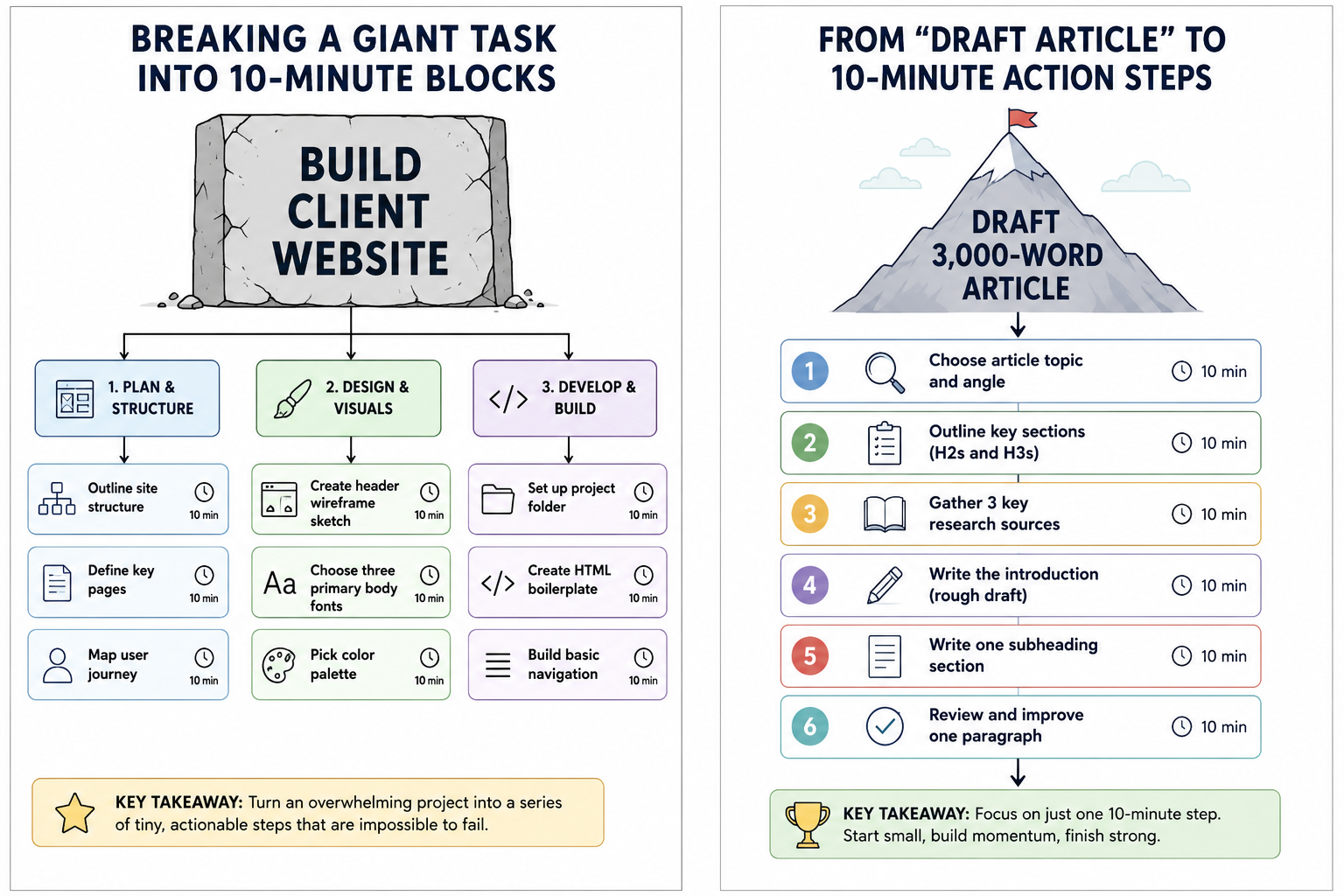 A giant, vague project broken into a hierarchy of tiny, manageable 10-minute steps.
Let us look at how this works in practice. Imagine you are a freelance writer who needs to draft a comprehensive, 3,000-word article. If you write "Draft article" on your sticky note, you are setting yourself up for task paralysis. Your brain immediately starts calculating forty different variables at once. How should the introduction sound? What research points do I need to include? How do I structure the conclusion?
Instead, apply the 10-Minute Rule to slice that terrifying mountain into a tree of micro-tasks. Your schedule should look like this:
- Open a blank document and save it as "Article Draft - Version 1." (1 minute)
- Type out three main section headers based on the project brief. (4 minutes)
- Write down two bullet points of raw ideas under the first header. (5 minutes)
Notice the nature of these micro-tasks. They require absolutely zero creative genius, deep inspiration, or heavy mental lifting. They are entirely mechanical, highly specific, and strictly limited in scope. You are not committing to writing a masterpiece. You are not even committing to writing a full paragraph. You are only committing to spending a few minutes performing a single, predictable physical action.
When you reduce the scale of your work to this degree, you drop the barrier to entry down to zero. The primary objective of the 10-Minute Rule is not actually to complete your entire project in ten-minute increments. The objective is simply to initiate action.
In psychology, there is a concept known as the Zeigarnik effect, which shows that human beings remember interrupted or uncompleted tasks much better than completed ones. More importantly, an uncompleted task creates a subtle form of mental tension. Once you actually begin a task — even a tiny, superficial piece of it — your brain develops a natural desire to see it through to completion. The friction is always highest before you start. By tricking your brain into working for just ten minutes on a simple step, you will frequently find that your momentum builds, and you actually want to keep going.
But here is the most important part of the rule: if your timer goes off after ten minutes and you still feel drained, you have full permission to stop working. You have met your goal. You made measurable progress, and that is a victory worth celebrating.
Procrastination is a structural problem, not a motivational one. By reducing every item on your daily schedule to a mechanical action that takes less than ten minutes, you stop triggering your brain's threat response and make starting effortless.
Managing the Drifts and Detours of Micro-Tasks
When people first hear about the 10-Minute Rule, they usually raise an obvious objection: "If I break a massive project down into ten-minute steps, won't I end up with an endless, terrifyingly long checklist?"
This is a completely valid concern. If you take a massive project and turn it into a flat list of three hundred tiny steps, you will experience a different kind of task paralysis. Looking at a massive, flat wall of text is just as overwhelming to your prefrontal cortex as looking at a single, vague goal. The brain looks at the sheer volume of items and panics under the weight of the collective data.
The solution to this problem is structural hierarchy, not a long, flat checklist. Think of your work like a tree rather than a grocery list. The main trunk is your ultimate goal. The major branches are the phases of the project. The tiny twigs at the very ends of those branches are your ten-minute micro-tasks.
To keep your mind calm, you must practice selective visibility. You only ever need to look at one single twig at a time. By hiding the rest of the tree and focusing your narrow attention entirely on the immediate ten-minute step in front of you, you protect your limited working memory from overload. You do not need to worry about step twenty while you are executing step one.
Another common hurdle is managing distractions during that tiny window of time. If you experience executive dysfunction or have a highly restless mind, a ten-minute block can still feel like a long time to sustain uninterrupted focus. You might start your ten-minute timer to write a single email, only to find yourself down a research rabbit hole five minutes later.
If you find your mind drifting midway through a micro-task, do not use it as an opportunity to beat yourself up. Self-judgment drops your dopamine levels further, making it even harder to restart. Instead, treat your drifting mind with compassion. Gently pause, look back at your written micro-task, and lower the scope even further if necessary.
If "write one paragraph" is causing your mind to wander, cross it out and change it to "write one sentence." If "clean the desk" feels too vague and causes you to drift, change it to "put three pens into the drawer." There is no step too small. The only rule is that the action must move you forward, even if it is only by a fraction of an inch. If you find that organizing your schedule into these deep visual structures is difficult to manage on paper, learning how to build an effective system for visual task architecture can transform your workflow.
How to Start Your First 10-Minute Block Today
You do not need to reinvent your entire life, download ten new applications, or completely reorganize your office to start using this framework. You can apply the 10-Minute Rule right now, today, to the single most intimidating, frustrating item currently sitting on your plate.
Here is a low-friction, step-by-step process you can follow in the next ten minutes to break your current cycle of task paralysis:
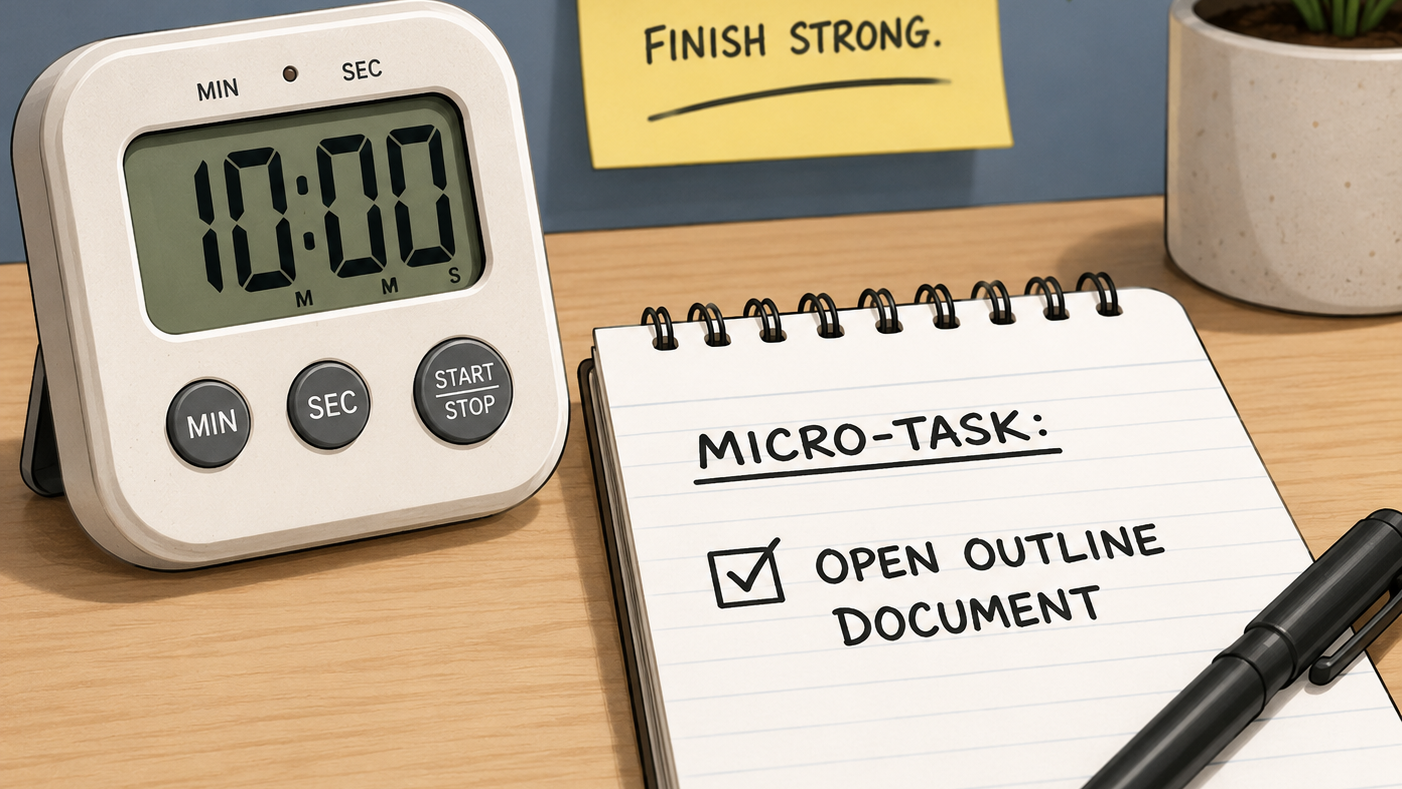 A physical timer and a single, clearly written micro-task — everything you need to break the freeze cycle.
- Isolate the monster. Pick the one project, assignment, or chore that you have been actively avoiding all week. Write it down at the very top of a piece of paper.
- Find the absolute first physical action. Ask yourself: "What is the very first physical movement I need to make to begin this?" Do not write down "research market trends." Write down "Open browser, go to Google, and type in two search terms." Isolate the entry point.
- Set a physical timer. Do not rely on your internal sense of time, and try not to use a timer on your phone if your phone is a major source of distraction. Use a kitchen timer, a desktop app, or a simple web countdown set for exactly ten minutes.
- Protect your environment. Close every browser tab that is completely unrelated to this single action. Put your phone in another room or switch it to a strict do-not-disturb mode. Minimize the sensory inputs competing for your attention.
- Execute without judging quality. Start your timer and perform the micro-task. Do not worry if your writing is terrible, if your code is messy, or if your design looks amateur. Your absolute only objective is to keep your hands moving until the timer rings.
Once the timer sounds, stop what you are doing. Take a deep, deliberate breath. You have officially broken the freeze state. You have shifted your brain from a state of anxious paralysis into a state of active momentum. You now have full, unconditional permission to stop working, close your laptop, and walk away entirely guilt-free.
However, what you will frequently discover is a surprising truth: once you cross that initial ten-minute threshold, the friction disappears. Your brain adjusts to the task, the anxiety drops, and you will often find yourself wanting to reset the timer for another ten minutes.
Small Steps Move Mountains
Our culture often tells us that major achievements require massive, heroic efforts. We are constantly surrounded by messages telling us to grind harder, hustle longer, and dig deep to find hidden reservoirs of raw willpower. But for anyone dealing with executive dysfunction, neurodivergence, deep burnout, or chronic procrastination, this advice is intensely frustrating and alienating. It treats a structural issue as a personal defect.
You do not need a monumental amount of willpower to build a life you love or to finish your important work. You simply need a gentle, dependable system that respects the reality of how your brain functions.
Great items are rarely built in single, breathless marathons. They are assembled piece by piece, day by day, through tiny moments of deliberate, manageable action. By adopting the 10-Minute Rule, you take the power back from your emotional freeze response. You give yourself permission to move slowly, to start small, and to make progress completely on your own terms. Trust the power of micro-steps, and watch how quickly the mountains in your life begin to shrink.
Maya Reyes
Maya writes about calm productivity systems for people who'd rather do the work than manage the to-do list.
Turn one scary project into a tree of small wins.
Branchify is built around the one move in this article: keep splitting until starting is easy. Free forever plan, no credit card, works right in your browser.
Launch plan
Branchify board
You might also like
All articles
Why Short, Honest Work Sprints Beat Long Grinding Sessions
Short focused work sprints turn work into timed blocks with real breaks, lowering the bar for starting and making stopping guilt-free today.

Why You Can't Start: Untangling Task Paralysis
Task paralysis isn't a willpower failure. It's what happens when a task is too big to act on — here's how to shrink it until starting feels obvious.