The Pomodoro Technique: Work in Short, Honest Bursts
Twenty-five minutes of focus, five minutes of rest, repeat. A timer can't do the work for you — but it can make starting feel small.

You don't need more willpower. You need a smaller container to put your work in — and a timer is one of the smallest, most forgiving containers there is.
What the Pomodoro Technique actually is
The Pomodoro Technique is a time-management method built around a single idea: work in short, timed intervals, then take a real break. The classic interval is 25 minutes of focused work followed by a 5-minute break — one "pomodoro." After four pomodoros, you take a longer break of 15–30 minutes before starting the cycle again.
The technique isn't about squeezing more hours of work out of your day. It's about making any single hour easier to start.
That's the whole method. No elaborate scoring system, no app required — just a timer, a task, and an agreement with yourself about when you'll stop.
Where it came from
The technique gets its name from the kitchen timer its creator, Francesco Cirillo, used as a university student in the late 1980s — a wind-up timer shaped like a tomato, pomodoro in Italian. Cirillo was struggling to stay focused on his studies and challenged himself to commit to just ten minutes of focused effort at a time. As that small commitment became easier to keep, he stretched the interval, eventually settling on the 25-minute sprint that the method is known for today.
What started as a personal experiment in showing up for ten minutes became a structure that has held up for decades — not because the number 25 is magic, but because the underlying shape (commit briefly, rest honestly, repeat) maps onto how attention actually works.
How the cycle works
The mechanics are intentionally simple:
- Choose one task — something specific enough that you'd recognize progress on it.
- Set a timer for 25 minutes and work on that task only, until the timer rings.
- Take a 5-minute break. Stand up, stretch, look away from the screen — anything that isn't more work.
- Repeat. After four work intervals, take a longer break of 15–30 minutes before starting a new round.
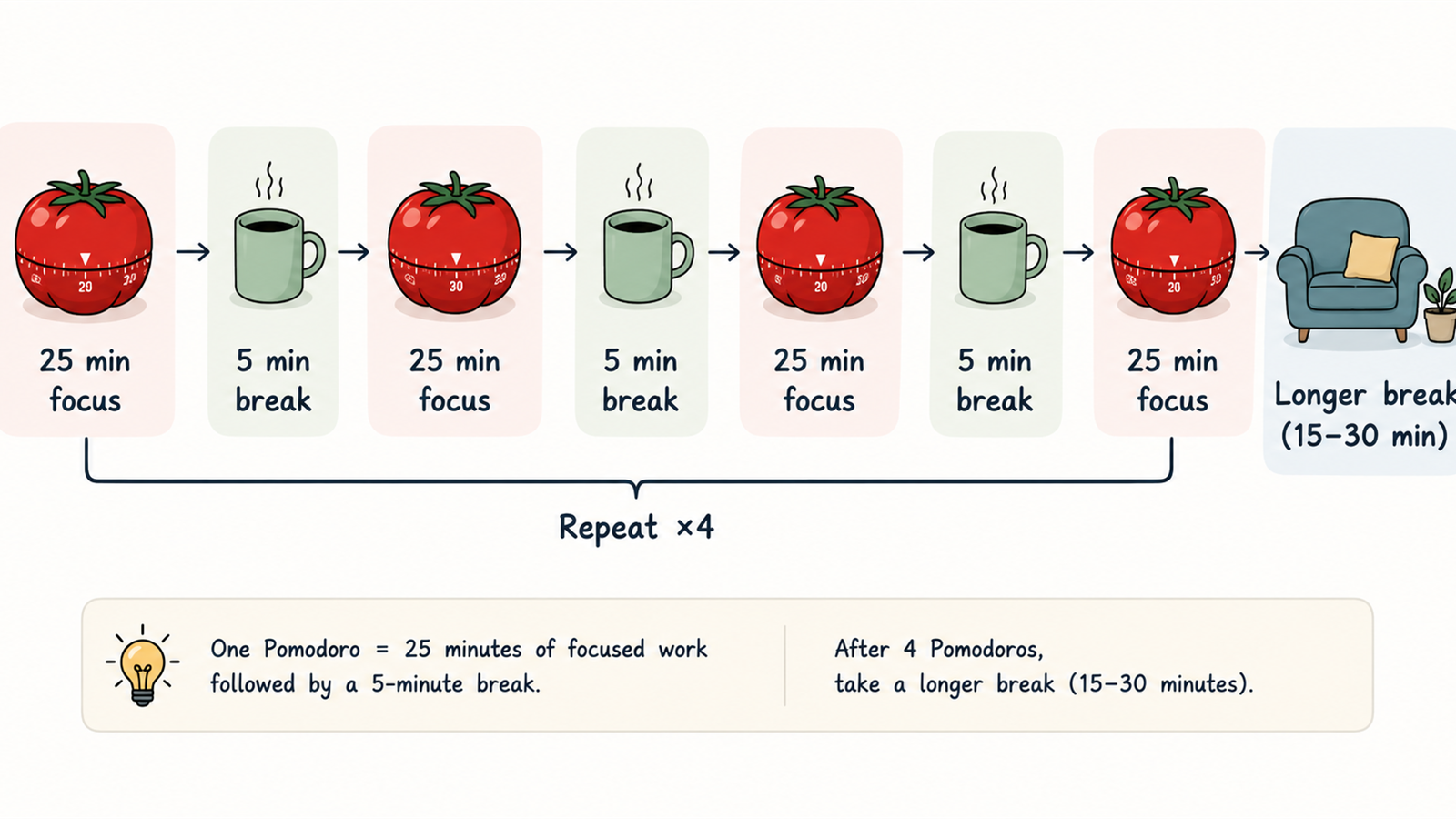 One full round: four short sprints, four short breaks, then a longer rest before you go again.
The break is not optional
It's tempting to skip the break when you're "in the zone." Resist that. The break is what makes the next sprint possible — it's not a tax on your focus, it's the maintenance that keeps focus available. A cycle without real rest isn't a more efficient Pomodoro session; it's just regular work wearing a tomato costume.
Why such a small container works
The Pomodoro Technique works less because of time management and more because of what it does to the moment right before you start.
Most procrastination isn't laziness — it's a response to a task that feels too large, too vague, or too open-ended to begin. Staring down "finish the proposal" with no boundary in sight is genuinely uncomfortable, and your brain will look for an exit. A 25-minute box changes the proposition entirely. You're no longer agreeing to finish the proposal — you're agreeing to work on the proposal until a timer rings. That's a much smaller, much safer thing to say yes to.
This is the same mechanism behind breaking a large task into smaller branches: the task itself doesn't get easier, but the first commitment does. A timer adds a second kind of boundary — not just "how much," but "how long" — and for many people, the time boundary is the one that finally makes starting feel safe.
It also reduces decision fatigue. Once the timer starts, the next question is no longer "Should I keep going?" or "Is this enough?" The agreement is already externalized: keep attention on this one branch until the bell rings. That little bit of externalized urgency can be especially helpful when a task has built up into the "wall of awful" — the emotional pileup that makes starting feel heavier than the work itself.
There's a quieter benefit, too: the break gives you permission to stop. People who struggle to start often also struggle to stop, sliding into long, joyless stretches that make the next start even harder. Knowing a break is coming — and taking it — keeps work from curdling into the kind of marathon that makes tomorrow's task paralysis worse.
Using the Pomodoro Technique in Branchify
Branchify's focus timer is built around exactly this rhythm. When you open a task, you can start a Pomodoro-style session directly from it — choose a work/rest preset (the classic 25/5 is the default, with longer ultradian options for deep-focus stretches), and a floating timer keeps the session running in the background while you work.
The pairing with Branchify's branching model is intentional. Branching answers "what's small enough to start?" The Pomodoro Technique answers "how long do I have to keep going once I do?" Together, they remove both excuses at once: the task is small, and the commitment is short. Pick a leaf-level branch, start a focus session on it, and let the timer hold the boundary so you don't have to negotiate it with yourself every few minutes.
Start smaller than you think you need to
If 25 minutes feels like too much right now, shorten it. Cirillo himself started at ten. The number isn't the technique — the shape is: commit briefly, rest on purpose, repeat without guilt. Set a timer for whatever feels almost-too-easy, finish it, and notice that starting the next one is just a little easier than it was before.
Maya Reyes
Maya writes about calm productivity systems for people who'd rather do the work than manage the to-do list.
Turn one scary project into a tree of small wins.
Branchify is built around the one move in this article: keep splitting until starting is easy. Free forever plan, no credit card, works right in your browser.
Launch plan
Branchify board
You might also like
All articles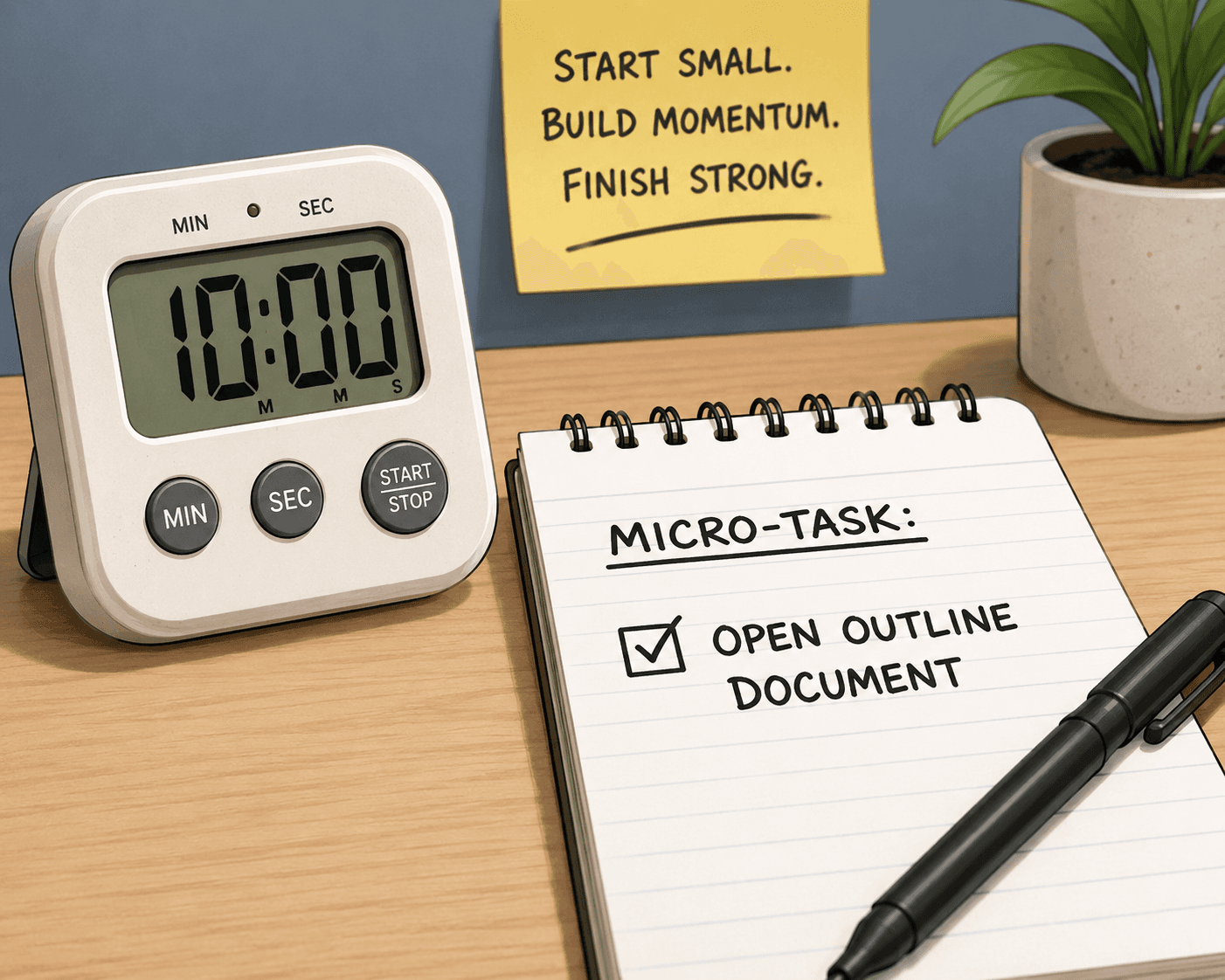
The 10-Minute Rule: Make Any Task Small Enough to Start
The 10-Minute Rule breaks any overwhelming task into tiny, frictionless steps, eliminating the freeze response and making it easier for your brain to start.

Why You Can't Start: Untangling Task Paralysis
Task paralysis isn't a willpower failure. It's what happens when a task is too big to act on — here's how to shrink it until starting feels obvious.